'/%3e%3cpath%20id='Vector_2'%20d='M23.4134%2014.5948C24.0891%2013.9112%2024.7108%2013.1282%2025.2444%2012.3115C25.6968%2011.6199%2026.5564%2010.5256%2026.271%209.64115C26.1243%209.18538%2025.6449%209.03531%2025.2117%208.99582C18.6413%208.39678%2010.4183%2014.5598%205.41161%2020.3235C4.37146%2021.5205%203.17337%2022.7885%203.08087%2024.4627C2.96467%2026.5554%205.16793%2027.767%206.84548%2028.2905C9.10402%2028.9955%2011.7033%2029.1411%2014.0114%2028.5375C15.2671%2028.2093%2016.4291%2027.6993%2017.3993%2026.8374C17.8855%2026.4053%2018.304%2025.8999%2018.6289%2025.3359C18.8106%2025.0189%2018.6741%2024.6105%2018.3379%2024.4672C17.7332%2024.2088%2016.5994%2023.9291%2014.7323%2024.1727C14.4886%2024.2043%2014.5259%2024.1829%2014.4999%2023.9877C14.4762%2023.805%2014.4706%2023.5647%2014.465%2023.5308C14.4413%2023.3977%2014.5778%2023.4282%2014.791%2023.3955C17.5324%2022.9713%2020.5152%2022.3429%2022.6869%2020.521C23.137%2020.143%2023.5443%2019.7346%2023.8748%2019.2473C23.9786%2019.0938%2024.0745%2018.9359%2024.1636%2018.7746C24.3204%2018.4869%2024.2866%2018.1304%2024.0677%2017.8856C23.6537%2017.4231%2021.9276%2016.8782%2020.6844%2016.806L20.6901%2016.7563C20.8401%2016.5995%2021.1278%2016.4901%2021.3105%2016.3671C21.5441%2016.2092%2021.7708%2016.0434%2021.9919%2015.8685C22.4838%2015.4804%2022.961%2015.054%2023.4134%2014.5959V14.5948Z'%20fill='url(%23paint1_linear_20736_1314)'/%3e%3c/g%3e%3cdefs%3e%3clinearGradient%20id='paint0_linear_20736_1314'%20x1='5.04346'%20y1='5.86175'%20x2='5.04346'%20y2='18.9333'%20gradientUnits='userSpaceOnUse'%3e%3cstop%20stop-color='%236B4EFF'/%3e%3cstop%20offset='1'%20stop-color='%234F92F6'/%3e%3c/linearGradient%3e%3clinearGradient%20id='paint1_linear_20736_1314'%20x1='16.0608'%20y1='15.1348'%20x2='16.0608'%20y2='28.9146'%20gradientUnits='userSpaceOnUse'%3e%3cstop%20stop-color='%236B4EFF'/%3e%3cstop%20offset='1'%20stop-color='%234F92F6'/%3e%3c/linearGradient%3e%3c/defs%3e%3c/svg%3e)

Listening at Scale: Notes from a Pilot with UNESCO's MIL Alliance
In October 2025, UNESCO partnered with Agora to support Media & Information Literacy (MIL) Week, spanning Cartagena, Mumbai, and Bangkok.
Global events generate energy, insight, and powerful exchanges. But they are also fleeting. Panels end. Participants disperse. The richness of disagreement, nuance, and emerging consensus is often difficult to preserve.
This pilot explored whether a structured digital deliberation space could extend the life of those conversations and enhance participant experience.
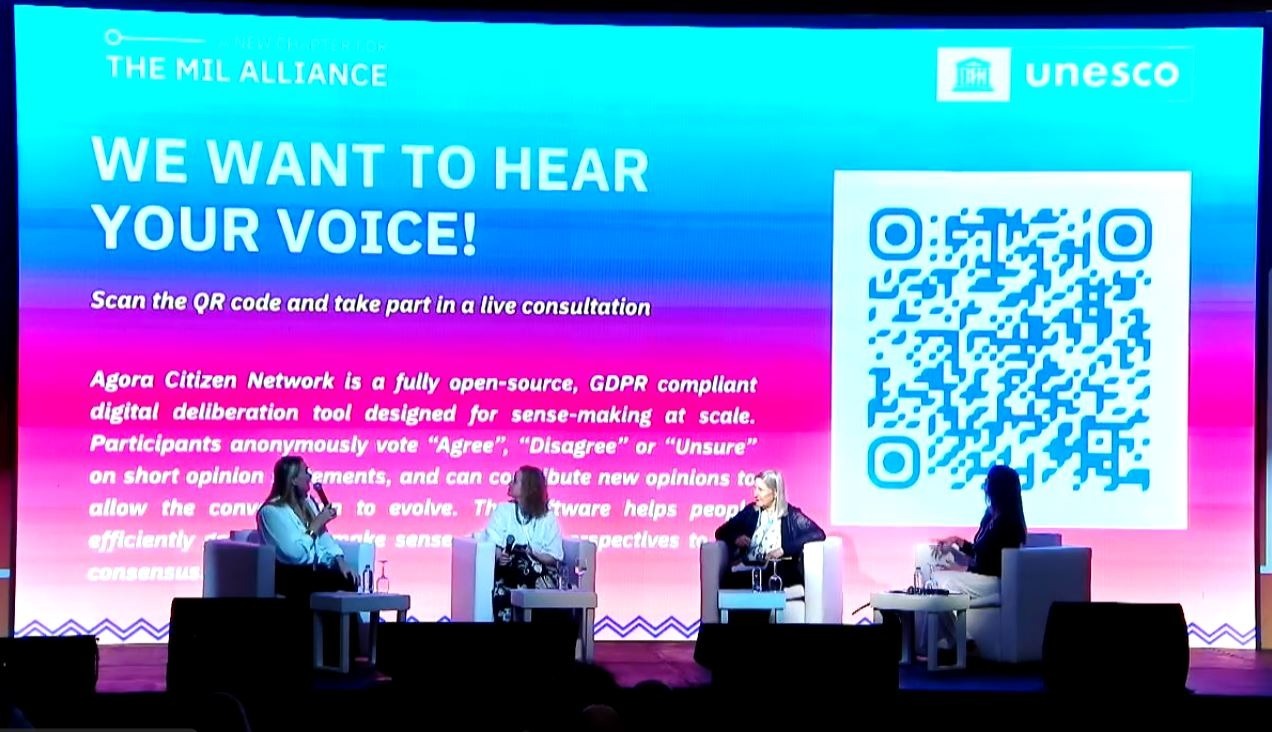
The Experiment
Throughout the event, participants, both on site and online, were invited to use Agora to respond to short statements related to two themes:
- The governance of the MIL Alliance
- Strategic priorities for the coming years
Rather than positioning the platform as a parallel "online event," the goal was to create a shared space where participants could:
- Contribute structured perspectives.
- Engage with and vote on others' arguments.
- Identify areas of convergence and divergence.
- Continue reflecting beyond the scheduled sessions.
The process was intentionally lightweight. Participants joined voluntarily, exploring the themes at their own pace. As the day progressed, clusters of agreement and disagreement began to emerge. Some priorities drew broad alignment across participants. Others revealed fault lines that were not obvious in plenary discussions.
What Became Visible
One of the effects of the pilot was how it changed the texture of participation.
People who might not raise a hand in a large room could still contribute. Remote participants were no longer limited to watching — they were part of the same dialogue space. For some people, simply seeing where their views sat relative to others was meaningful.
As one attendee later reflected:
"Agora made the event feel lively and interactive with participants actively sharing thoughts and reacting in real time, while the live analytics allowed trends to emerge clearly. It really brought the conversation to life and fostered a collaborative and inclusive atmosphere."
— Nicolas Adegboyega, Event Attendee, UN Department of Political and Peacebuilding Affairs
For organizers, instead of a long list of qualitative feedback to be interpreted later, the outcome was a structured map of perspectives: areas of alignment, areas of divergence, and topics that warranted further discussion.
What the Numbers Showed
- 108 members joined the consultation.
- 85 distinct perspectives were shared.
- 1,063 votes were cast across contributions.
- 2 in-depth post-event analyses were conducted, surfacing patterns not immediately visible during live discussions.
Beyond participation metrics, the more significant outcome was durability. The conversation did not disappear when the event ended. Participants and event organizers could revisit the discussion, explore areas of convergence and divergence, and reflect on the broader landscape of views.
Rather than a moment of exchange, the consultation became a shared reference point — something that could evolve and be revisited over time.
What This Pilot Was and Wasn't
This was not a vote. It did not produce binding decisions. It did not aim to manufacture consensus.
What it offered was something more modest but useful: a way to listen more carefully at scale.
For the UNESCO MIL Alliance, this experiment suggested a complementary approach to global consultation — one that can widen participation without flattening complexity.