'/%3e%3cpath%20id='Vector_2'%20d='M23.4134%2014.5948C24.0891%2013.9112%2024.7108%2013.1282%2025.2444%2012.3115C25.6968%2011.6199%2026.5564%2010.5256%2026.271%209.64115C26.1243%209.18538%2025.6449%209.03531%2025.2117%208.99582C18.6413%208.39678%2010.4183%2014.5598%205.41161%2020.3235C4.37146%2021.5205%203.17337%2022.7885%203.08087%2024.4627C2.96467%2026.5554%205.16793%2027.767%206.84548%2028.2905C9.10402%2028.9955%2011.7033%2029.1411%2014.0114%2028.5375C15.2671%2028.2093%2016.4291%2027.6993%2017.3993%2026.8374C17.8855%2026.4053%2018.304%2025.8999%2018.6289%2025.3359C18.8106%2025.0189%2018.6741%2024.6105%2018.3379%2024.4672C17.7332%2024.2088%2016.5994%2023.9291%2014.7323%2024.1727C14.4886%2024.2043%2014.5259%2024.1829%2014.4999%2023.9877C14.4762%2023.805%2014.4706%2023.5647%2014.465%2023.5308C14.4413%2023.3977%2014.5778%2023.4282%2014.791%2023.3955C17.5324%2022.9713%2020.5152%2022.3429%2022.6869%2020.521C23.137%2020.143%2023.5443%2019.7346%2023.8748%2019.2473C23.9786%2019.0938%2024.0745%2018.9359%2024.1636%2018.7746C24.3204%2018.4869%2024.2866%2018.1304%2024.0677%2017.8856C23.6537%2017.4231%2021.9276%2016.8782%2020.6844%2016.806L20.6901%2016.7563C20.8401%2016.5995%2021.1278%2016.4901%2021.3105%2016.3671C21.5441%2016.2092%2021.7708%2016.0434%2021.9919%2015.8685C22.4838%2015.4804%2022.961%2015.054%2023.4134%2014.5959V14.5948Z'%20fill='url(%23paint1_linear_20736_1314)'/%3e%3c/g%3e%3cdefs%3e%3clinearGradient%20id='paint0_linear_20736_1314'%20x1='5.04346'%20y1='5.86175'%20x2='5.04346'%20y2='18.9333'%20gradientUnits='userSpaceOnUse'%3e%3cstop%20stop-color='%236B4EFF'/%3e%3cstop%20offset='1'%20stop-color='%234F92F6'/%3e%3c/linearGradient%3e%3clinearGradient%20id='paint1_linear_20736_1314'%20x1='16.0608'%20y1='15.1348'%20x2='16.0608'%20y2='28.9146'%20gradientUnits='userSpaceOnUse'%3e%3cstop%20stop-color='%236B4EFF'/%3e%3cstop%20offset='1'%20stop-color='%234F92F6'/%3e%3c/linearGradient%3e%3c/defs%3e%3c/svg%3e)

Can 30 People Agree on AI Rules in a Day?
How should a 30-person engineering startup use AI, and where should it refuse to? In September 2026, Jean Lou Fourquet of Lyfe Catalyst, an expert facilitator, spent a full day on that question with the startup's whole team.
Most company workshops end with good intentions and nothing to act on. This one ended with a draft AI charter: principles the team agreed on across their differences, then ranked themselves.
The difference came from using both of Agora's modes in sequence. Conversation mode mapped where people agreed and disagreed throughout the day. Prioritization mode then turned the consensus statements into a ranked list of shared priorities.
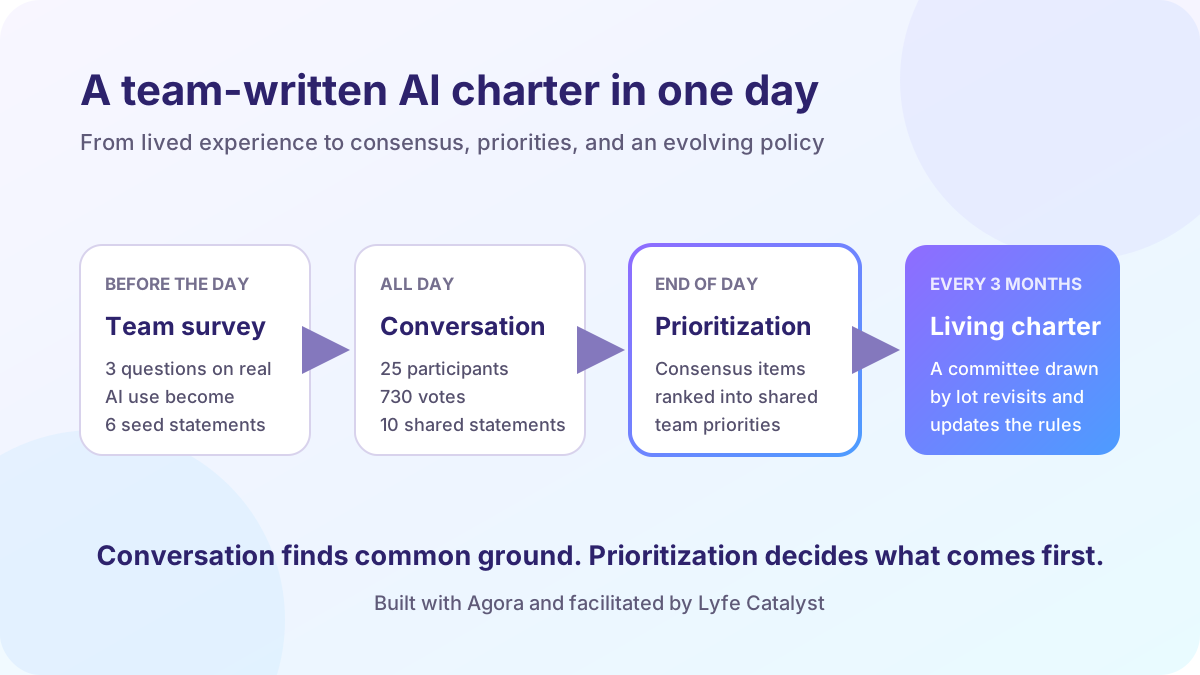
Conversation mode surfaces what the group agrees on; Prioritization mode decides what comes first.
The Challenge: Workshops That Inform but Don't Decide
A training day on AI usually follows a familiar script: expert talks, a lively discussion, a few sticky notes. Everyone learns something, but nothing is decided. The takeaways stay in the room, often shaped by the loudest or most senior voices.
For the startup, the stakes were concrete. Team members used AI tools in different ways and to different degrees, with no shared rules. Some questions were about risk: can the plans and parameters of the company's machines go into an external AI assistant? Others touched on the company's identity: the company promotes a 30% cut in its machines' energy consumption, so how much energy-hungry AI use is consistent with that?
The goal of the day was explicit: not just to raise awareness, but to leave with a first draft of a charter on AI use, written and owned by the team.
Before the Day: From Real Practice to Seed Statements
The seed statements were built from the team's own experience, not from a generic list. Before the workshop, participants answered a three-question form:
- The last time you used a generative AI tool (ChatGPT, Claude, Copilot) at work, what exactly did you ask it, and what did it save or cost you?
- If you had to convince a colleague who never uses AI, which single use case in your job is really worth it, and why?
- If you had to warn a colleague who uses AI all the time, which single case should never involve AI, and why?
The answers were synthesized into seed statements: concrete, debatable proposals in the team's own vocabulary. Some were rules, some good practices, and some open tensions. For example:
- "We should use AI to rephrase and clarify reports from notes engineers have already written, never to generate the content itself."
- "We should ban external AI assistants for anything involving the plans, diagrams and technical parameters of our machines."
- "Before adopting a new AI tool, we should assess its environmental footprint against the time or quality it actually saves."
- "We should encourage using AI to quickly explore sizing or calculation options during design, with engineers keeping the final decision."
The conversation description set the bar for new contributions: a concrete proposal beats an abstract principle. Rather than "we must be responsible", write "we should always check AI-produced figures before putting them in a client deliverable".
During the Day: One Conversation, Open From Morning to Afternoon
The Agora conversation "How do we want to use AI in our company?" opened live at 9:00, with everyone joining from their phone. It stayed open all day, with a QR code on display.
Participants were asked to:
- Vote "Agree", "Disagree" or "Unsure" on every statement
- Share new ideas
- Come back regularly to vote on new statements
The program alternated short talks and discussions: how AI works, its environmental and societal impacts, principles for democratic digital technology, and thoughtful uses in research and engineering. Each session ended with a prompt that sent participants back to Agora to vote and add statements. The talks fed the conversation, and the conversation fed the next discussion.
At 15:45, the group stepped back to read the map together. The divisive statements were named and noted, not smoothed over. The aim was to see the group as a group: not "what I think", but where the team stands, before focusing on common ground.
Key Findings: Common Ground and Live Disagreements
By the end of the day, 25 participants had cast 730 votes on 42 statements. Only 6 were seed statements: the other 36 were written by participants as the day unfolded.
What everyone agreed on
Agora identified 10 statements approved by both opinion groups. The common ground formed a clear core:
- Verify: use AI for scientific and technical watch only if you go back to the original source. At 84% agreement, this was the most supported statement of the day.
- Disclose: technical documents produced with AI must say so (68%, no one disagreeing).
- Protect: no external AI assistants for anything involving the plans, diagrams and parameters of the company's machines (68%, no one disagreeing). Any company data sent to an AI must be approved by the company (60%).
- Train: every new employee learns the internally approved AI uses from day one (64%).
Strikingly, 7 of the 10 consensus statements were written by participants during the day, not by the organizers.
What divided the room
- "Before asking AI a question, staff should first check that competent colleagues don't already have the answer."
- "Should we develop our own in-house AI, unique to the company?"
Yet the room was not split for or against AI. Only 8% agreed that AI should not be used at the company at all. The disagreements were noted as open questions for the charter, not forced into agreement.
Two opinion groups
- Pragmatists (15 people, 60%): see AI as a useful tool when used responsibly. All of them backed AI for technical watch with source checks, and for automating tedious processes. They want personal data protected and AI subscriptions paid for by the company.
- Humanists (6 people, 24%): put human expertise and interaction first. 83% think the societal and environmental costs of generative AI far outweigh its benefits for speeding up tasks, compared with 20% of Pragmatists. Two-thirds agree AI should never fully automate a process that involves human interaction.
Unclustered participants (4 people) voted on fewer than 7 statements.
From Consensus to Priorities: Ranking the Charter
Consensus tells a team what it agrees on. It does not tell it where to start. That is why the day did not stop at the map.
The 10 statements that reached cross-group consensus were moved into a second Agora conversation, this time in Prioritization mode. Participants ranked them against each other. The goal was not completeness, but a short list that stands out on both consensus and priority.
The highest-ranked shared priorities included:
- We should be careful about the confidential content we might expose when using AI, to prevent data leaks, theft of processes, and so on.
- We allow AI to speed up scientific and technical watch (summaries of articles and patents), provided we always go back to the original source before relying on the information.
- When AI is used for research, the user must check at least some of the sources.
At 16:30, the draft charter was read aloud as it emerged from the ranking. The team adopted it as a living document, and every three months a committee drawn by lot will revisit it.
Why This Matters: Sensemaking, Not Brainstorming
A brainstorm collects ideas. Sensemaking shows a group what it actually thinks. Agora's map gave the room two things to work with: common ground to build on, and divisive points worth deliberating. Participants could go deeper where they disagreed and collaborate where they already agreed.
The two modes answer two different questions:
- Conversation mode: what do we agree on, across our differences?
- Prioritization mode: of what we agree on, what matters most?
Together, they turn a day of talks into an outcome the team owns. The rules were not handed down by management or by the facilitators. They came from the people who will apply them.
Looking Forward
The charter is designed to evolve. The quarterly committee drawn by lot keeps it alive as tools, uses and the team itself change.
The format travels well beyond AI: any organization facing a shared decision can follow the same path.
A workshop doesn't have to end with good intentions. With the right process, it ends with shared priorities the whole team stands behind.
Want to run a workshop like this?
Lyfe Catalyst, an official partner of Agora, can design and facilitate a workshop for your team, community, students, or partners—on AI or any other shared decision. Get in touch with Lyfe Catalyst.
Already an experienced facilitator? Start using Agora now or talk to us directly.