

Mapping Dreams and Nightmares About the Future
What future do you hope for? What future do you fear? Who might experience your dream as their nightmare?
On October 21, 2026, our co-founder Yuting Jiang and François Taddei, founder of the Learning Planet Institute, led an online workshop at Plurality University Network’s Untameable Futures gathering.
François’s ethical dream-weaving method asks people to share their hopes and fears for the future, consider how those futures might affect people outside the room, future generations and other species, and look for dreams that can coexist.
We used Agora Citizen Network to help the room see where its visions overlapped and where they pulled in different directions.
How the workshop worked
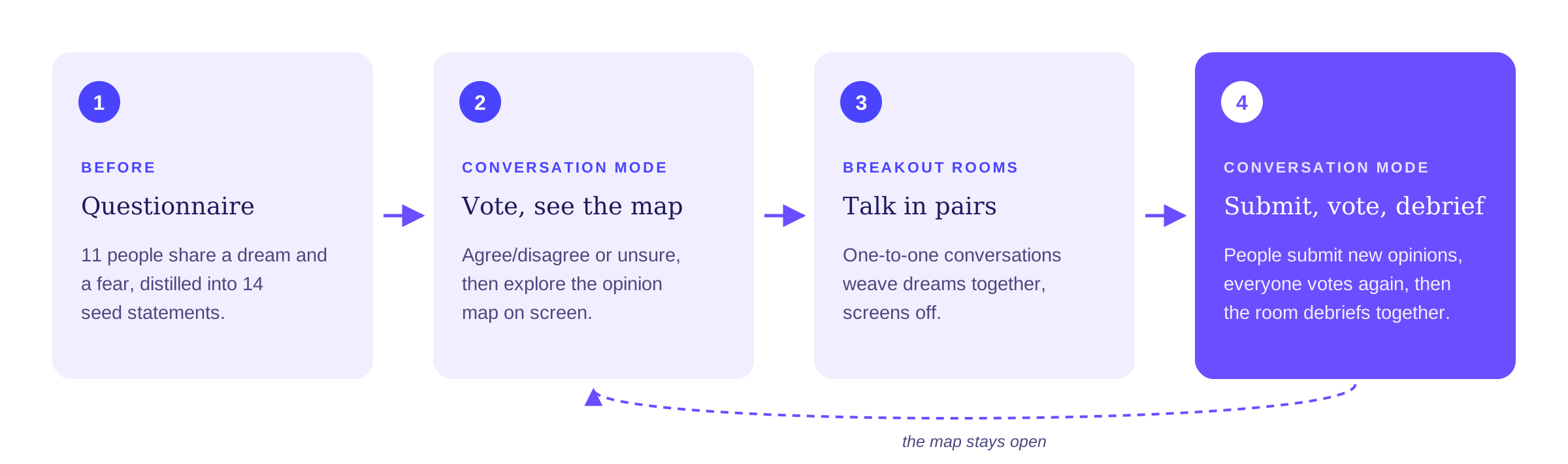
- Collect hopes and fears. Before the workshop, 11 people shared a dream and a fear in a questionnaire. We distilled their responses into 14 statements that participants could vote on.
- Vote and read the map. In Conversation Mode, participants chose Agree, Disagree or Unsure on each statement they voted on. The room looked at the first opinion map together.
- Talk in pairs. Participants stepped away from the voting interface for one-to-one conversations about how their dreams might fit together.
- Submit, vote and debrief. Participants returned to Agora to propose new statements and vote again. The group debriefed with the updated map, and the conversation stayed open.
How Agora maps opinion groups and finds common ground
Agora uses Red Dwarf, an open-source machine learning engine, to group participants by how they vote across statements. The calculations are deterministic and reproducible with the same votes and settings, and anyone can audit them in the source code. Agora can use a large language model afterward to name the groups and summarize their most representative statements.
Agora compares how each opinion group voted on the same statement. Bridging statements draw support across groups, revealing what they agree on despite their differences on other issues.
What the map revealed
By the end of the session, 34 people had cast 616 votes on 23 statements. Participants wrote nine of those statements during the workshop.
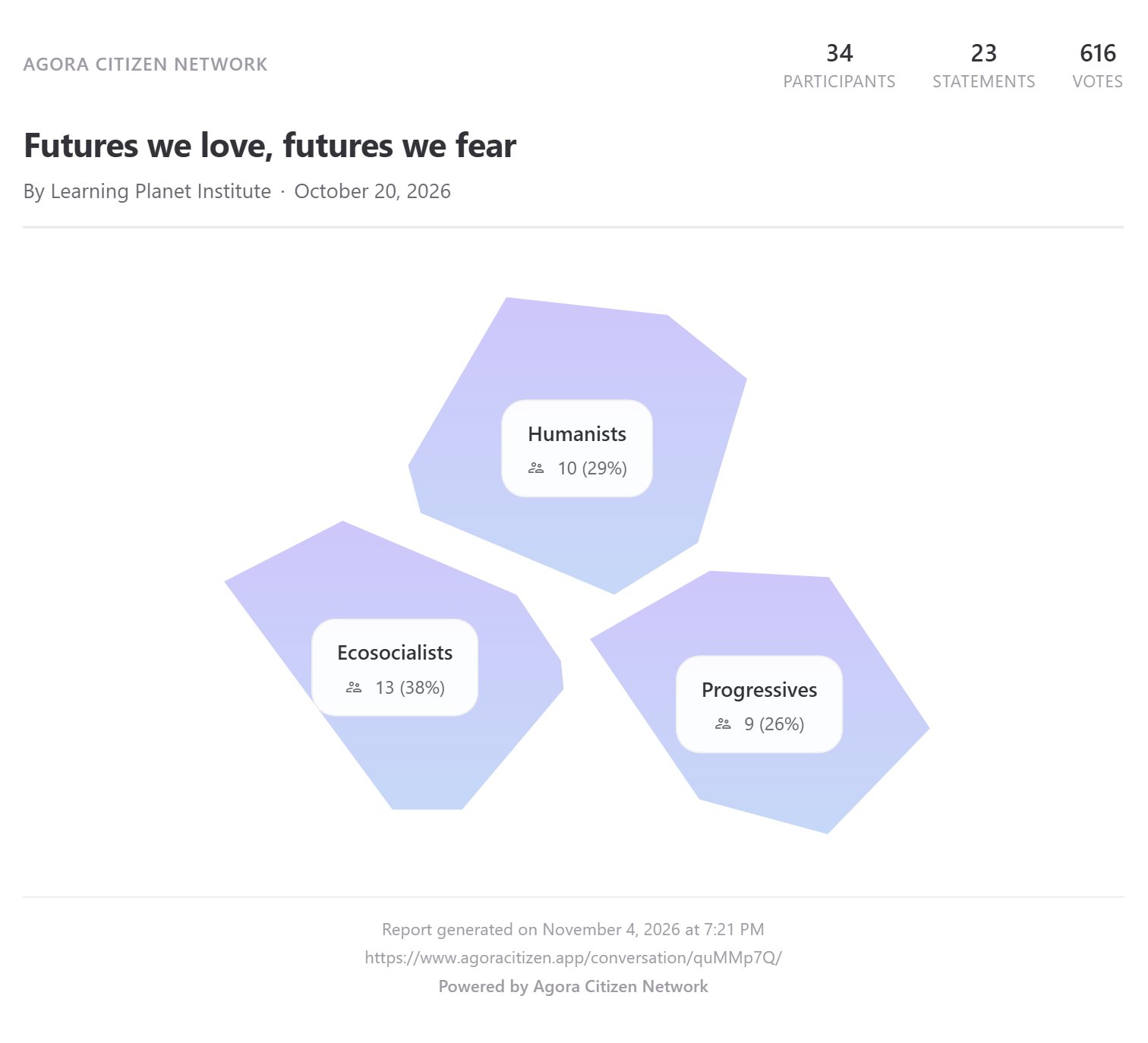
The map surfaced three opinion groups. Humanists valued in-person connection and worried about technology weakening our ability to think. Progressives were more hopeful about technology and online connection. Ecosocialists were more supportive of moving beyond capitalism and giving rights to nature.
The statement that clean rivers and air for future generations should come before economic growth drew more than 90% support in every group. Two participant-written statements also drew support across all three groups:
- “Imagination is infrastructure that can be built.”
- “In a desirable future, we can continue to strongly disagree on what a desirable future is.”
The second statement captures the spirit of ethical dream-weaving. Honoring our diversity of perspectives drives progress by helping us see possibilities we might miss on our own.
If you run this exercise, bring one divisive statement and one with support across groups to the debrief. Ask which dreams could coexist, what would make that possible, and whose perspective is still missing. Read Agora’s facilitation guide.
For more on ethical dream-weaving and the discussion at Untameable Futures, see Plurality University Network’s original recap.